Table of Contents
Gillingham High Performance (GHP)
Gillingham High Performance, usually abbreviated GHP, was an American line of torsion-spring hand grippers created by Wade Gillingham. Production began in 2010 and the main range ultimately ran from GHP Level 1 through GHP Level 10.[1] Gillingham announced in January 2024 that the company had no immediate plans to continue manufacturing grippers after working through its remaining parts during 2023.[1]
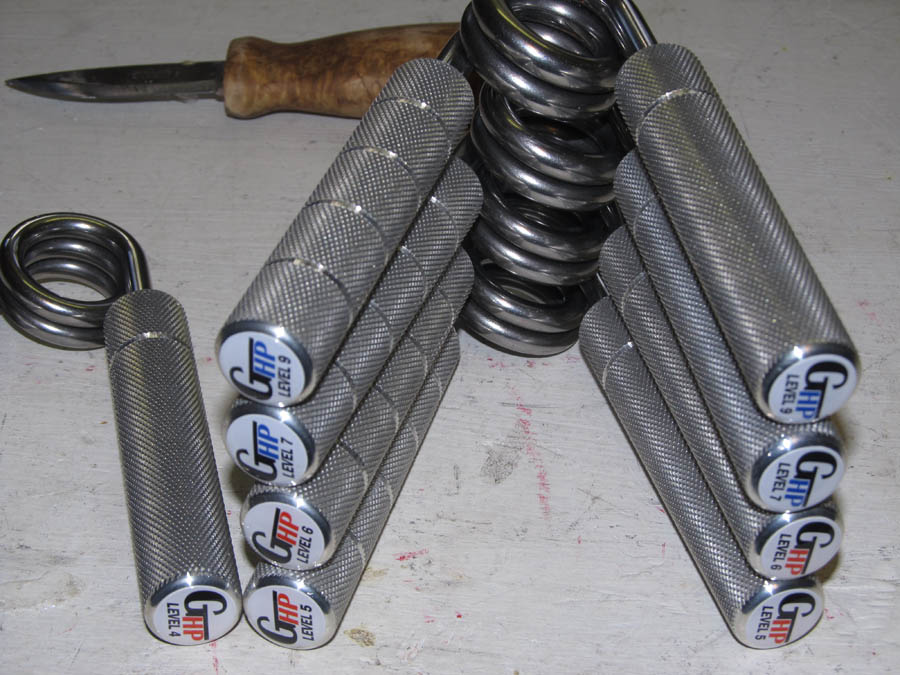
Early GHP grippers photographed and RGC-rated by GripBoard member macaz in December 2011.[2]
- Founder: Wade Gillingham
- Country: United States
- Known production period: 2010-2023
- Main range: GHP Level 1 through Level 10
- Other range: Five smaller Junior levels
- Status: Production inactive; remaining retail stock is depleted or intermittent
Development
In his 2024 manufacturing announcement, Wade Gillingham said the project began in 2010 with the goal of making a high-quality torsion-spring gripper with a reproducible feel.[1] Period owner reports show full-size GHP grippers reaching customers by December 2011.[2]
The line used numbered difficulty designations rather than names. Ten full-size levels were made, ending with the unusually difficult Level 10. The printed or advertised poundage attached to a level was a manufacturer designation, not an RGC result and not the literal force applied by a user's hand. Individual examples vary.
Design
GHP grippers used aluminum handles, a steel torsion spring and several distinctive handle features.
Two handle textures
A 2011 owner examining Levels 4, 5, 6, 7 and 9 reported that the finger-side handle had a slightly smoother texture while the palm-side handle used more aggressive knurling.[2] This intentional difference helped the palm handle remain planted while allowing the finger-side handle to move during the sweep.
Finger-index bands
Machined bands around the handles provided visible and tactile finger-position references. These bands are also useful for distinguishing the two main production generations.
Spread and sweep
Contemporary owners frequently measured spreads near 3 inches on harder examples and described the grippers as stiff through the sweep.[2] Spread, spring mounting depth, wire dimensions and individual manufacturing variation all affect closing difficulty, so model number alone cannot predict the exact RGC rating of a specimen.
Full-size levels
The regular series contained ten numbered levels:
| Training range | Models |
|---|---|
| Introductory | GHP Level 1-3 |
| Intermediate | GHP Level 4-6 |
| Advanced | GHP Level 7-8 |
| Exceptional | GHP Level 9-10 |
This grouping is descriptive, not an official certification standard. The levels should not be converted to Captains of Crush numbers or other brands solely from nominal poundage.
RGC examples and variation
The first large GripBoard calibration discussion began in December 2011. One owner recorded the following unseasoned examples straight from their sealed packaging:[2]
| Gripper | Reported RGC |
|---|---|
| GHP Level 4 | 92.8 lb |
| GHP Level 5 | 112.3 lb |
| GHP Level 6 | 135.0 lb |
| GHP Level 7 | 149.1 lb |
| GHP Level 9 | 226.3 lb |
These are measurements of five individual grippers, not official averages. The same discussion documented substantially different impressions and ratings from other examples, especially in the upper levels.[2] A 2024 collector listed, among others, Level 4 examples at 87 lb RGC, a Level 5 at 110, a Level 6 at 128, a Level 7 at 143 and a Level 8 at 176.[1]
A particularly hard Level 10 in a collector's possession was reported at 279 lb on that owner's rating setup.[3] GripperVault also preserves photographs and collection records for surviving Level 10 examples.[4] Differences in apparatus, procedure and individual grippers make cross-source comparisons approximate unless the same rating method is used.
Production generations
Collectors identify two principal generations. Cannon PowerWorks founder Matt Cannon summarized the differences in 2024:[5]
| Feature | First generation | Second generation |
|---|---|---|
| Handle-end stickers | Domed GHP level stickers on both handles | One GHP level sticker and one United States flag sticker |
| Finger-index bands | Wider bands | Narrower bands |
| Top bevel | Rounded or curved, matching the bottom | Angled bevel, sometimes with visible machining marks |
These traits are more useful for dating an example than handle color alone. Replacement or missing stickers can complicate identification.
Junior grippers
GHP also offered smaller Junior grippers in five levels. They were discussed as youth or small-hand grippers and used dimensions distinct from the full-size line.[1] When production ended, Cannon PowerWorks purchased GHP's remaining Junior components—enough for approximately 120 grippers across all five levels—and stated that the assembled grippers would not carry GHP branding.[1] Consequently, an unbranded gripper assembled from those parts should not automatically be cataloged as a production GHP Junior.
Packaging
A 2011 owner reported receiving GHP grippers in heat-sealed plastic bags with a small desiccant packet.[2] Original packaging can therefore help document provenance, especially when a handle sticker has been lost.
GHP Gripper Challenge
GHP operated a separate closing challenge or certification program. Wade Gillingham stated in January 2024 that the future administration and location of its results were still being discussed.[1] Gripperpedia covers the rules and historical context on the separate GHP Certification page rather than reproducing the external athlete roster here.
The Level 10 eventually became a documented certification gripper as well as a collector model. Because certification rules and approved techniques can change, a model close should not be described as an official certification unless it was accepted by the program.
End of production
Gillingham said that GHP spent 2023 consuming the remaining component inventory and offered only limited sizes during the second half of that year. He attributed the halt to the cost of maintaining the manufacturing standards established when the project began.[1]
Cannon PowerWorks now labels GHP grippers out of stock for the foreseeable future and states that GHP is not currently able to supply wholesalers.[6] This supports treating the line as inactive rather than merely temporarily sold out, while leaving open the possibility of a future restart.
Identification checklist
A full-size GHP should generally have:
- A numbered GHP level marking
- Aluminum handles with finger-index bands
- Different palm-side and finger-side knurling
- Either two GHP end stickers or a GHP sticker paired with a United States flag
- A torsion spring sized for its level
- On an unopened early example, heat-sealed packaging and a desiccant packet
Photographs of the handle ends, top bevels, index bands and spring mounting are particularly useful when separating first- and second-generation examples.
External resources
- Wade Gillingham's 2024 production announcement
- Cannon PowerWorks GHP collection page
- 2011 GripBoard calibration and design discussion
- First- and second-generation identification discussion
- GripperVault GHP Level 10 example
- Wayback Machine search for Gillingham High Performance
References
- Wade Gillingham, "GHP Announcement," GripBoard, January 4, 2024. The thread includes Gillingham's production history and Matt Cannon's disposition of the remaining Junior components. ↩
- GripBoard, "GHP Grippers Calibrated," begun December 22, 2011; contemporary owner measurements, packaging notes and design observations. ↩
- GripBoard, "Incredible GHP10 Gripper in the Mail," June 5, 2021; owner measurement of an unusually hard Level 10. ↩
- GripperVault, "Gillingham High Performance (GHP) Level 10," collection record and photographs. ↩
- Matt Cannon, reply in "GHP grippers, difference between generations?," GripBoard, April 15, 2024. ↩
- Cannon PowerWorks, "Gillingham High Performance," current collection status. ↩